You heard about Mux from a developer, an API comparison, or the stack behind another product. The purchase question is more basic than the feature list: is it a maintained platform you can trust with a sales video, and what work arrives after you sign up?
Mux is a real developer video platform. Its own site describes the product as “Video for developers,” and the catalog covers upload, encoding, storage, delivery, playback, analytics and AI workflows. The fit question is sharper for a VSL. Mux gives your team the video infrastructure, but your team still owns the selling layer around it.
Our verdict comes from the vendor’s current product and pricing pages plus long-term user reports. We did not run Mux on a live VSL campaign. For the exact research method, see the methodology page linked below.
What Mux actually ships
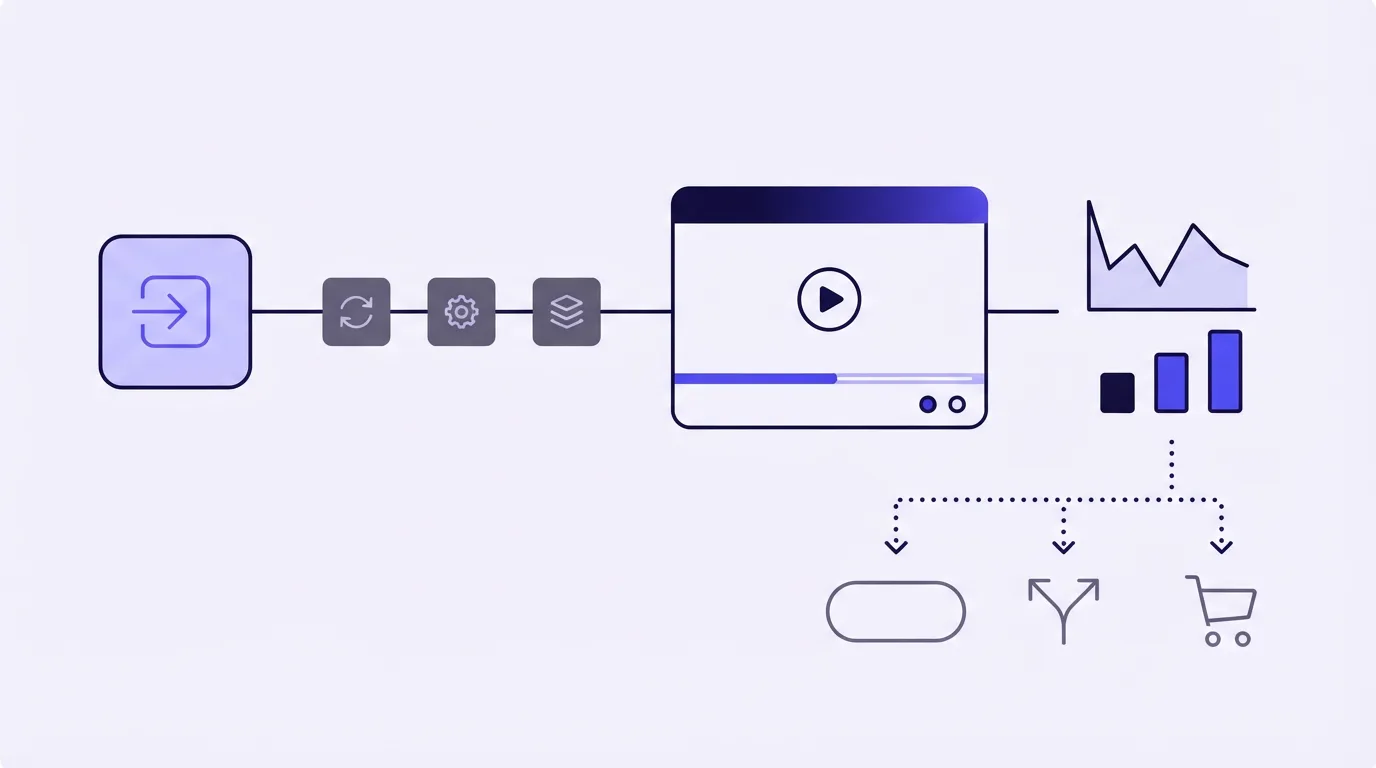
The core is the Video API. It handles on-demand and live video, including RTMP and SRT ingest. Mux says live latency can be as low as four seconds. Mux Player gives you an open-source player layer, while Mux Data adds engagement and quality-of-experience analytics. The current pricing page includes those advanced analytics rather than selling them as a separate analytics subscription.
Protection goes beyond a signed link. Signed URLs and domain restrictions are included, and media-grade DRM is available as a paid add-on. That makes Mux a more credible candidate for premium course content than infrastructure that stops at token access. Just-in-time encoding is another meaningful difference: Mux says three-quarters of uploads become playable within five seconds.
Mux Robots covers AI-assisted workflows such as moderation, summaries, chapters, caption translation and questions about a video. Those jobs sit beside the delivery pipeline. They do not turn the player into a direct-response conversion product.
The VSL layer is still your build
The catalog has no built-in sound-first unmute-restart autoplay, timed in-video CTA, sales split test or cart-verified attribution. Mux can host the video, expose playback data and give developers the parts for a custom experience. It does not ship the finished funnel controls a marketer expects from a dedicated VSL host.
That limitation matters even to a team with one offer. You still need to decide how the CTA appears, how a checkout event returns to the viewer record and how Meta or TikTok receives the sale. For a multi-account media buyer, the missing routing and postback layer creates more engineering work because each funnel needs reliable identity and event handling. The delivery, player and analytics remain useful in both cases.
What third-party users say
The positive case is engineering flexibility. In a web-development thread, one commenter wrote, “Mux is excellent if you have strong dev resources.” The same discussion reduced the trade-off to “you pay for flexibility.” That is a fair summary of the product: it removes video-pipeline work while leaving product and funnel decisions with your team.
Cost reports split by architecture and volume. A Hacker News commenter said Mux was “cheaper than S3 in most cases” for their comparison. A SaaS founder offered the counterweight: “Mux can get expensive at scale.” Both can be true because a managed pipeline replaces more than raw object storage, while a long video watched by a large audience accumulates delivered minutes quickly.
Support is the least settled part of the evidence. A verified review shown on a G2 comparison page said a response “might take days.” That quote comes from a comparison page rather than a standalone Mux review, so we treat it as a support pattern to investigate, not a verdict on every account.
Mux pricing: what each tier buys
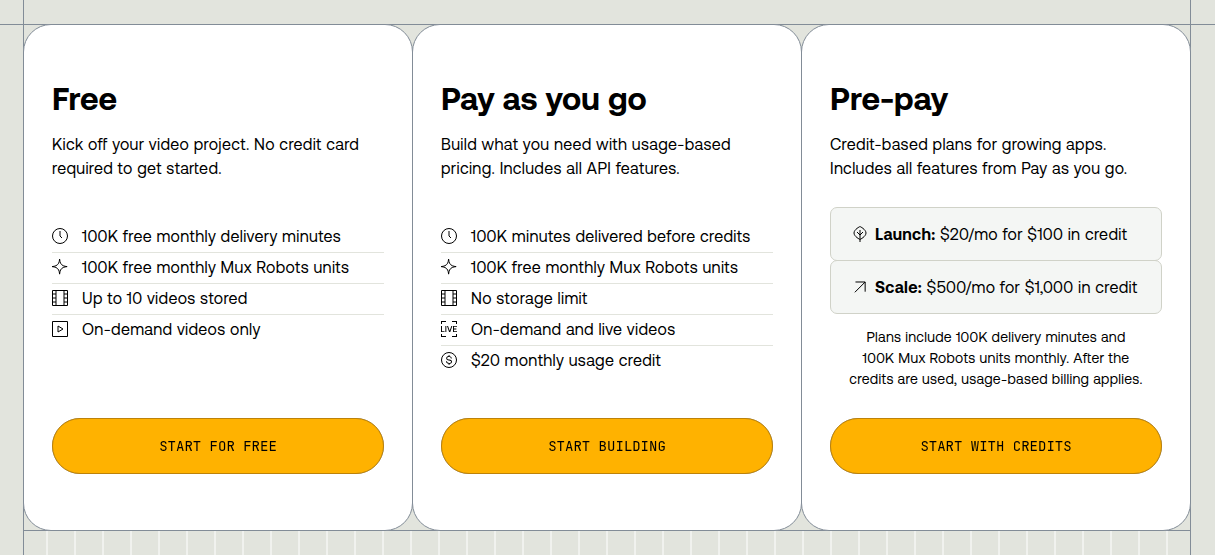
Mux pricing combines a generous free allowance with usage billing and prepaid credit plans. The free tier needs no card and includes 100,000 delivery minutes each month, 100,000 Mux Robots units and storage for up to ten on-demand videos. Pay as you go keeps the 100,000-minute allowance, adds a $20 monthly usage credit, removes the storage cap and supports both live and on-demand video.
| Tier | Monthly commitment | Included value | Who it fits |
|---|
| Free | $0 | 100K delivery minutes, 100K Robots units, up to 10 stored videos | Prototype an on-demand integration |
| Pay as you go | Usage billed after allowances and credit | $20 monthly usage credit, live and on-demand, no storage cap | Variable workloads without a prepaid tier |
| Launch | $20/month | $100 usage credit | A small production workload |
| Scale | $500/month | $1,000 usage credit | Higher predictable usage |
| Enterprise | Custom | Contract terms | Large or negotiated deployments |
At 720p, storage is $0.0024 per minute per month. Delivery starts at $0.0008 per minute after the monthly free allowance. A long sales video on cold traffic therefore makes watch time the main variable. A thirty-minute file is cheap to store, but every partial or complete viewing adds delivered seconds to the bill.
Mux Player and Mux Data are included. Media-grade DRM costs $100 per month plus $0.003 per play, and custom domains cost $100 per month. Signed URLs and domain restriction remain available without that DRM add-on. Those add-ons can matter more than the base delivery rate for a small protected library.
Mux vs Cloudflare Stream: analytics depth or simpler billing
Cloudflare Stream bills on two dimensions: $5 per month for each 1,000 minutes of storage capacity and $1 per 1,000 delivered minutes. Encoding and ingress are included. Mux lists 720p delivery at $0.80 per 1,000 minutes after its free allowance and bills delivered video by the second, while Cloudflare charges by the minute.
The unit price does not settle the choice. Mux includes Mux Data engagement analytics, offers media-grade DRM and markets a broader AI workflow surface. Cloudflare offers a simpler storage-and-delivery model for a team already operating on its network. Mux says most uploads become playable within five seconds through just-in-time encoding, which can matter when uploaded video must appear quickly inside a product.
For a VSL, the tie-breaker is what your developers want to own. Mux buys analytics and protection depth. Cloudflare buys a simpler bill and infrastructure familiarity. Neither supplies the conversion layer, so autoplay behavior, timed calls to action, funnel experiments and sale attribution remain an application project.