You saw VdoCipher recommended in a course-hosting thread, usually as the answer to someone asking how to stop students downloading lessons. The question behind the search is simple: is this a real company with real protection, or an expensive name for a password on a video?
It is real. VdoCipher is a secure video host built around studio DRM. Its homepage leads with “Google Widevine & Apple FairPlay DRM,” and it sells to e-learning companies, media sites and anyone serving premium video behind a login. Our verdict comes from VdoCipher's own product, FAQ and pricing pages plus long-term user reports on G2, Trustpilot and Reddit. We did not run VdoCipher on a live course or campaign, and the methodology page explains how we research instead.
What DRM video hosting means here
Most hosts protect a video with a private link, a domain allowlist or a signed URL. Those stop casual embedding. They do not stop a browser extension from saving the file. DRM changes what the file is: VdoCipher encrypts the video when it encodes it, and the stream only decrypts inside its own player. A downloader that grabs the stream gets encrypted data it cannot play.
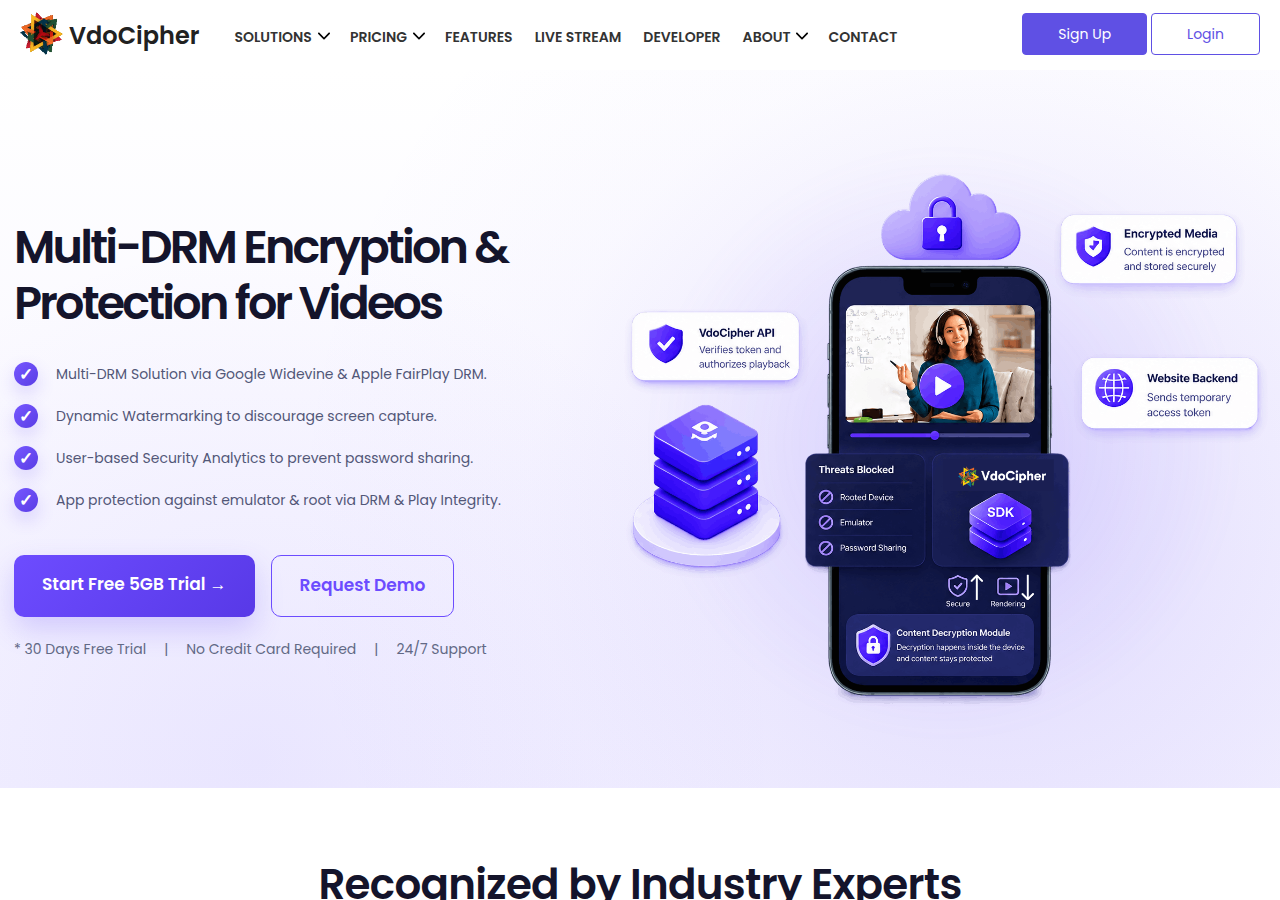
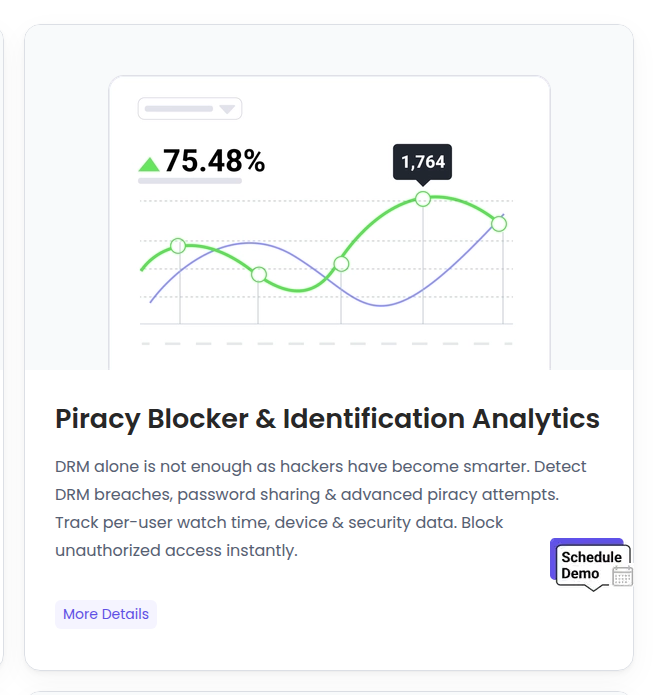
The vendor is open about where that stops. Its hosting page says illegal downloads are stopped on all major browsers and apps, while screen capture is prevented only in mobile apps and Safari. On desktop Chrome and Firefox, a determined pirate can still record the screen. That is why VdoCipher pairs DRM with dynamic watermarking on major browsers and Android apps, which its DRM page presents as a way to discourage screen capture. Its homepage puts it bluntly: “DRM alone is not enough as hackers have become smarter,” and it markets piracy analytics for spotting breaches and shared passwords on top.
Who it fits, and the job it skips
VdoCipher fits a seller whose catalog is the product: a course library, a members' lesson archive, a paid webinar replay, a media subscription. It plugs into WordPress and Moodle with plugins, and into custom apps through a REST API and mobile SDKs. A course creator on one of those stacks can protect lessons without building a player.
On this site we judge hosts on whether the video sells. VdoCipher does not try to. Its product scope has no sound-first autoplay, no timed sales calls to action, no split testing and no cart-verified attribution. For a lesson library none of that is missing. For the enrollment video that runs on Meta or TikTok ads, it is, and most course sellers end up hosting that one video somewhere else.
DRM video hosting: how VdoCipher compares
Several hosts we review offer some form of DRM. The difference is how much of the rest you get with it, and what you pay to switch it on.
Panda Video is the closest overlap for a course seller. It pairs a DRM watermark and anti-download controls with a VSL player and embeds for more than twenty course and membership platforms, so one host can serve both the lessons and the sales video. VdoCipher goes deeper on protection with full Widevine and FairPlay encryption and piracy analytics, and does nothing for the sales side.
Bunny Stream sells multi-DRM as part of cheap usage-priced delivery, with no course features around it. It suits a team with a developer that wants protection at infrastructure prices. VdoCipher costs more per gigabyte and gives you the WordPress and Moodle plugins and a finished secure player in exchange.
Vimeo has the better course toolkit, with chapters, quizzes and SCORM export, but studio DRM is an Enterprise add-on there. Mux offers media-grade DRM as a monthly add-on for developers building their own product. If either of those is your other finalist, the question is whether you want DRM bundled into every plan, as VdoCipher does, or bolted onto a broader platform.
For the full ranking on sales-video criteria, see the best video hosting for VSLs, and for the lesson-library question specifically, our course creator picks. If you have already decided against it, our VdoCipher alternatives rank the other options.
What third-party users say
The positive reviews come from course sellers who stayed. One G2 reviewer, writing after more than a year on the platform, called it “very dependable” and credited the DRM with protecting their videos “from unauthorized access and piracy.” Another put the outcome in one line: “We use it to host paid courses and haven’t had piracy issues since switching.”
The critical reports go after the edges of the protection and the playback. A Trustpilot reviewer argued that “simply zooming out in the browser window makes the watermark practically useless,” which matters most on desktop browsers where screen capture is not blocked. On Reddit, an operator who built a streaming site on VdoCipher posted that “now users are getting tons of errors” after launch. That is one thread, but DRM playback depends on the viewer's browser and device in ways an unencrypted stream does not, so test the trial on the browsers your students actually use.
VdoCipher pricing and plan tiers
VdoCipher pricing is annual. Every plan prepays a year of bandwidth and storage, DRM is included on every tier, and the plan ends when the bandwidth is used up or after one year, whichever comes first. There are no monthly limits inside that year. The tiers below are the ones VdoCipher publishes on its own alternatives and Gumlet comparison pages.
| Plan | Per year | Bandwidth | Storage | Who it fits |
|---|
| Starter | $149 | 1,000 GB | 100 GB | A first course or small library |
| Value | $399 | 2.5 TB | 200 GB | A growing student base |
| Express | $699 | 5 TB | 400 GB | Several courses with steady rewatching |
| Pro | $1,599 | 15 TB | 1 TB | An established academy |
| Plus | $4,999 | 50 TB | 2 TB | Media or edtech at volume |
| Enterprise | Custom | Custom | Custom | Negotiated terms |
Two numbers decide which row you need. The first is bandwidth: a student who rewatches a module draws on the same yearly credit as a new viewer, so a course with heavy rewatching can exhaust Starter well before the year ends. The second is storage. VdoCipher's FAQ says accounted storage “generally varies anywhere from 2–5 times” the upload size, because each video is kept as several encrypted renditions for different devices and qualities. A 40 GB library can count as 80 to 200 GB, which already pushes it past Starter's 100 GB.
Live streaming is sold too, but VdoCipher says live streams go out without DRM encryption. If protecting live sessions is the reason you are shopping, plan on recording them and publishing the replay to the on-demand library. The trial runs 30 days with four videos and 5 GB of bandwidth and needs no card. The full breakdown sits on the VdoCipher pricing page.