Head-to-head
TrackPlay vs Adilo
Down to these two for a sales video? The pick depends on whether the ad account has to learn from the purchase.
Quick answer
Pick TrackPlay if you buy cold paid traffic and need the cart-verified sale posted back to Meta, TikTok and GA4 on the play that earned it; pick Adilo if you want unlimited streaming on a free plan, a built-in recorder and channels, and you are fine optimizing on retargeting pixels and in-player CTAs instead of server-side sale postbacks.
You are down to two hosts for one sales video. Both can play it on a landing page and put a button over the timeline. They part company on the purchase, and on whether those views show up on the invoice.
TrackPlay is a video host and analytics platform for paid-traffic video sales letters. One embed drops into the funnel. It is built to hold the opening and to tie every second watched to the person who bought. Adilo is a wider business host. It records, it hosts, and it publishes. Its homepage advertises plays and views with no streaming cap, on paid plans and on the plan that costs nothing.
If the ad account has to learn from the purchase, TrackPlay is the host in front of you. Adilo is the match when you also need a recorder and branded pages, and the streaming line has to stay quiet.
| TrackPlay | Adilo | |
|---|---|---|
| Best for | Paid-traffic VSLs | Unlimited streaming |
| From | $29/mo | See adilo.com |
| Billing | Per play | Storage-based |
| Free plan | Free, no card | Free forever, no card |
| Sale attribution | Server-side postbacks | Ad pixels only |
| Timed buttons | Cards and watch gates on the timeline | Buy buttons, lead forms, countdown timers |
| Cart postbacks | ClickBank, ClickFunnels, Kiwify, BuyGoods, Digistore24, WarriorPlus, JVZoo | No |
| Ad events | Meta, TikTok, Google Ads and GA4, browser and server | Facebook and Google pixels |
| Split test | Real sales, one embed | A/B split testing |
| Retention | Buyers and non-buyers, pitch marked | Play rate, heatmaps, drop-off, per viewer |
| Channel pages | No | Series, webinars, onboarding |
How the play gets tied to the sale
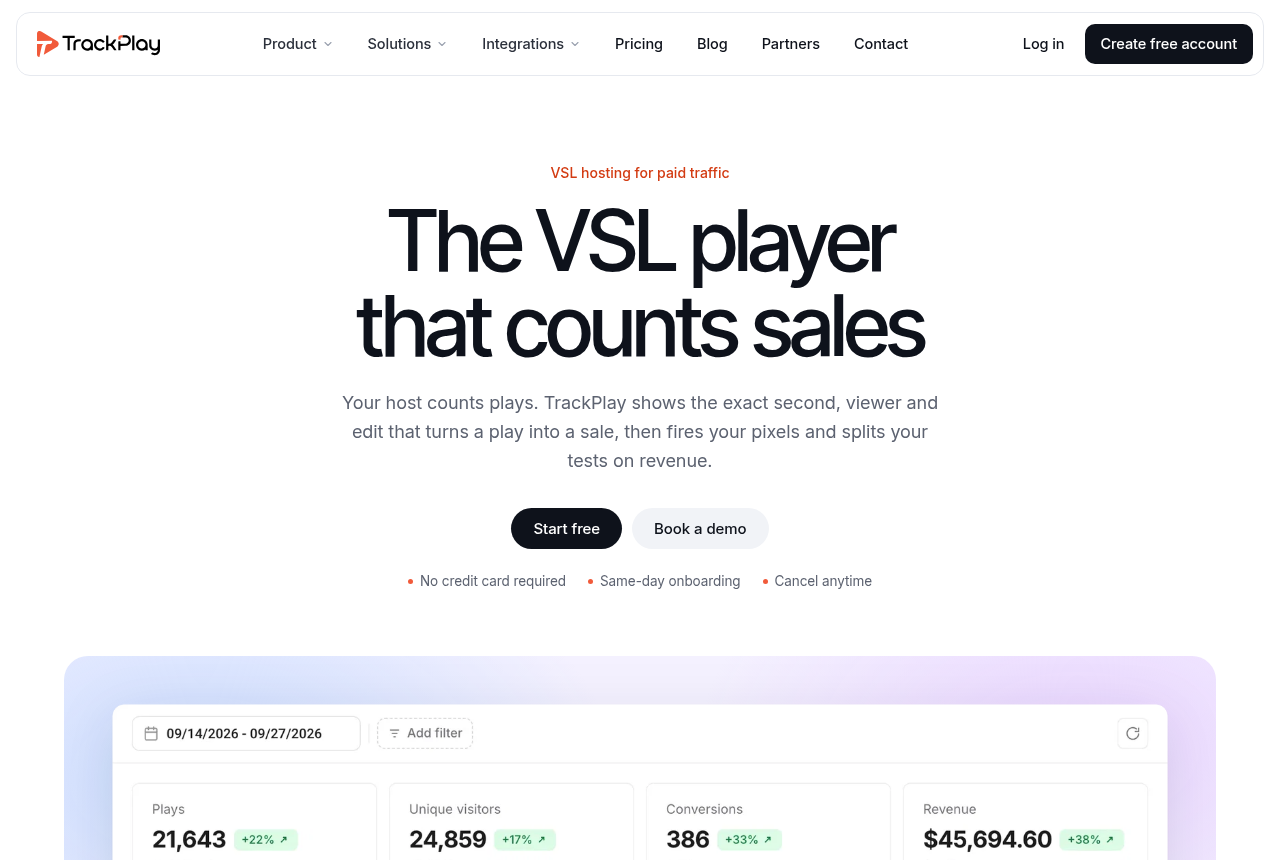
Smart Autoplay tries for sound on the first frame. Where the browser blocks sound, the video starts muted, and the first touch anywhere on the page turns the sound on without restarting. TrackPlay's homepage describes that unmute. Offer cards can wait until the pitch is on screen, and watch gates sit on the same timeline.
Retention on the features page is drawn per second. Buyers and non-buyers are separate curves, with the pitch marked on the timeline, and revenue per play sits with that chart. Treat it as an edit list. Protect the seconds buyers are still watching. Look hard at the seconds where everyone else leaves, especially when that exit comes before the pitch mark. The revenue figure is the check on whether the seconds you kept are earning the traffic that paid for them.
Every variant shares one embed. A fresh URL would reset what the ad platform has already learned. Swap the cut and the link in the ad stays the one already spending. The winner is the sales result, reported with a p-value and a confidence interval.
The carts in the table post the sale back onto the session, server to server. A watch-time event can fire at the mark you choose, from the browser and from the server. The TrackPlay review stays with the player controls.
A page-load pixel fires for anyone who reaches the page. The cart postback is the sale, attached to the session that watched. The watch-time event is the behavior, sent from the server at the point you set, and from the browser as well. An ad account that receives both is learning from the purchase and from the watch.
The limit is a content library
It is narrow by design. TrackPlay is built for a paid-traffic sales video whose job is a direct-response sale. Channels, SEO pages and webinar tooling are what a host like Wistia ships for a content library, and they sit outside this product. A sales video on paid traffic still has the autoplay, the buyer curve and the cart postback. The limit is the content-marketing job.
Outside proof is thin. Capterra's TrackPlay listing shows 0.0 based on 0 user reviews. That is what a new product looks like before independent write-ups exist. The testimonials you can read are on the vendor site. Free signup asks for a name, an email and a password, and a referral or coupon code on that form is optional.
Adilo keeps the recorder in the same account
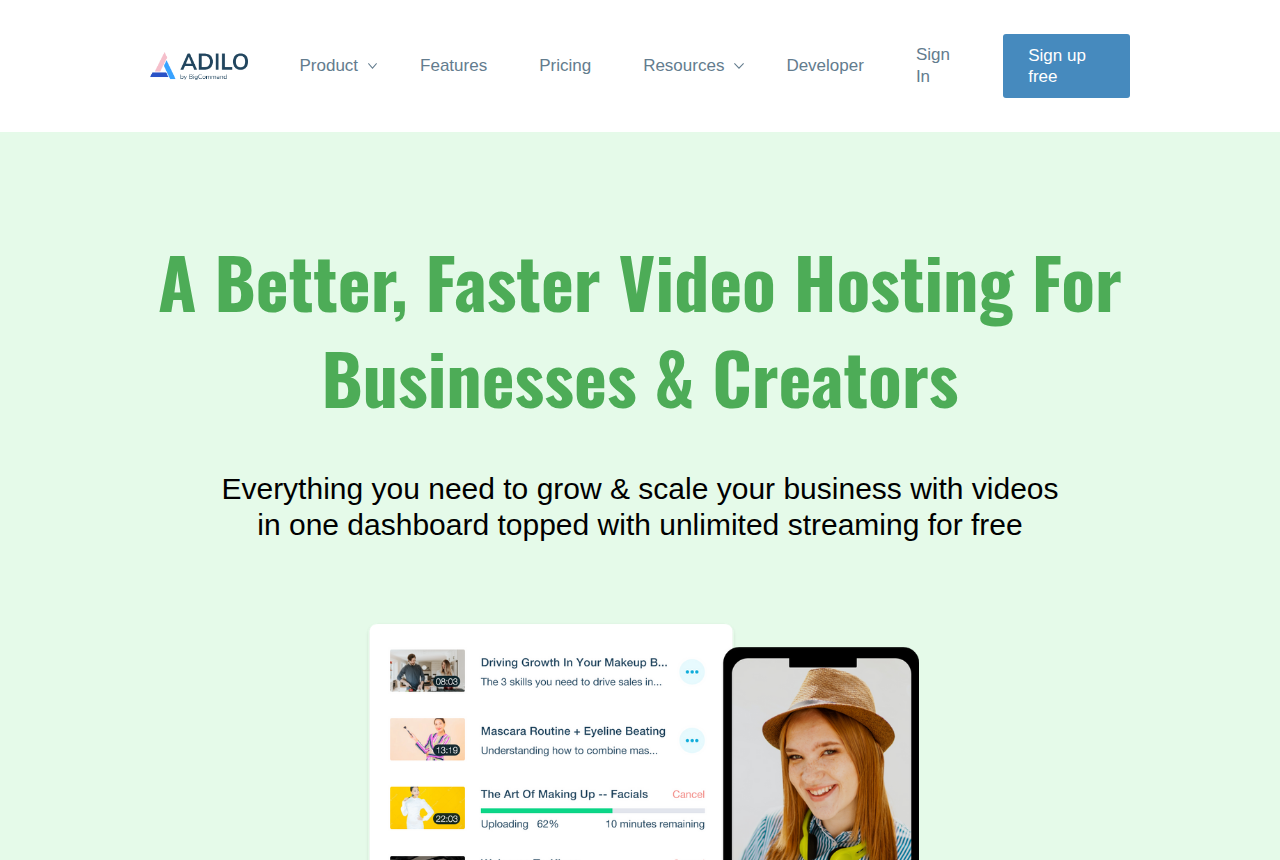
Adilo's homepage speaks to businesses and creators who want the file, the recorder and the buttons together. Plays and views carry no streaming cap. The screen and camera recorder is included, at 4K, with no cap on length. Branded pages hold a series, a webinar run or an onboarding library. The homepage describes those pages as your own mini show.
Inside the player you get buy buttons, lead capture, countdown timers and A/B split testing. A pixel installed in the video is what builds the retargeting audience from the view. The analytics page emphasizes play rate, drop-off points and a watch history for each viewer, and it talks about setting that record against conversions and conversations. DRM is an add-on. The Adilo review spends longer on the recorder.
That pixel is the right tool when the next audience is people who watched, or people who clicked the button in the player. The sale is a separate event. TrackPlay is the host that can send the sale back to the session. Adilo is the host that can record the take and retarget the view from one account.
The complaint that keeps showing up
Capterra reviews call Adilo very buggy. On Trustpilot, one reviewer wrote that they had contacted customer support more than 25 times to fix bugs or server issues over more than a year of use. Read that beside the feature list.
What the invoice does when traffic arrives
TrackPlay's meter is the play. A play is a genuine viewer session. Someone presses play, unmutes, resumes, restarts, or gets autoplay that already has sound. A muted autoplay nobody unmutes stays off the invoice, so a silent open that never earns a tap adds no charge. The pricing page is where that rule is written.
Basic is $29 a month for 5,000 plays. PRO is $79 a month for 15,000 plays. SCALE is $199 a month for 50,000 plays. Extra plays are opt-in, at $0.02 on Basic and $0.01 on PRO and SCALE. Every feature is included on every paid plan. The no-card plan pauses when its cap is hit, and there is no overage charge.
Adilo leaves plays and views off the streaming meter on every plan, including the plan that costs nothing, and that plan asks for no card. The paid Unlimited plan is priced by storage. Annual billing is advertised at 40 percent off. The monthly storage amount sits on Adilo's pricing page.
Adilo's quiet streaming line is the wide-audience case. A long video can run in front of a large audience and the view count never becomes a streaming fee. The trade is the sale on the session. Someone who optimizes on retargeting and in-video buttons can accept that. Someone whose ads are scored on purchases will care more that the play meter is attached to the event those ads learn from.
Our pick
TrackPlay
TrackPlay is the pick if you run paid traffic to a VSL and need every play tied to the actual sale.
Frequently asked questions
Which is better for a VSL on paid traffic?
Can either post the sale to Meta or TikTok?
Which host leaves bandwidth unmetered?
How much does each one cost?
Sources
The vendors' own pages
- TrackPlay homepage
- TrackPlay pricing
- TrackPlay features
- Adilo homepage
- Adilo pricing
- Adilo video analytics
Other sources
Related reading

Written by
Mara Vance
Editor
Mara edits the reviews and roundups on VSL Host Report. She checks autoplay, watch time, timed buttons, lead gates and page speed when the visitor is new and the traffic is paid. She also maps what each host really costs, whether it bills per play, per gigabyte or per seat, and rebuilds the monthly bill for a typical VSL funnel. For each piece she reads long-term user reports across forums and review sites, works through the vendor's own docs and pricing, and confirms the numbers before a verdict goes live.
Last checked 2026-10-15
Comments
No comments yet. Questions and your own experience are welcome.
Thank you. Your comment will appear once it has been reviewed.