VSL hosting cost calculator
Put in your video length, monthly visitors and watch rate to see what one sales video costs a month on each host.
You want to know what your sales video will cost to host before the ads go live, and every pricing page answers in a different unit. One host charges per play, another per minute delivered, a third per gigabyte, and a fourth a flat monthly fee. The headline price tells you very little until you run your own traffic through each of those meters.
This calculator does that for one video. It multiplies the length by your visitors and the average share they watch, converts the result into minutes, gigabytes or plays as each host bills, and prices it on the vendor's published list rates. It is an estimate for comparing hosts, so taxes, annual discounts, extra seats and the rest of your library are left out.
The short answer
A 20-minute VSL seen by 5,000 visitors a month who watch a quarter of it on average costs anywhere from nothing to $149 a month plus overage, depending on the host. The spread comes from how each one meters viewing, so the pricing model matters more than the sticker price.
Work out your monthly hosting cost
The defaults are the worked example below. Change any of them and press the button.
With the default numbers, the worked example below shows each host's monthly figure. The calculator recomputes it in your browser for your own numbers.
Worked example: one 20-minute VSL
Twenty minutes times 5,000 visitors times 0.25 is 25,000 minutes of video delivered in the month. At 3.33 Mbps each minute is about 0.025 GB, so the same viewing is roughly 624 GB. Here is what each host charges for it, cheapest first. The order is arithmetic and says nothing about which host sells better.
| Host | Billed on | Per month |
|---|---|---|
| Mux | Minutes stored and delivered | $0.00 |
| 25,000 minutes delivered sits well inside the 100,000 free monthly minutes, so the Free plan carries this video. | ||
| Bunny Stream | Gigabytes stored and delivered | $6.25 |
| Delivering about 624 GB at $0.01 per GB comes to $6.24, and storing the file adds under a cent. | ||
| Voomly | Flat plan | $19.00 |
| Basic stops at 20 GB, so this much viewing lands on Plus, which has unlimited bandwidth for $19. | ||
| Panda Video | Bandwidth tier | $21.63 |
| Bronze at $17.90 includes 500 GB, and the 124 GB above it at $0.03 adds about $3.73. | ||
| TrackPlay | Plays | $29.00 |
| With one play per visitor the month comes to 5,000 plays at most, which fits inside the 5,000 that Basic includes. | ||
| Cloudflare Stream | Minutes stored and delivered | $30.00 |
| One $5 storage block covers the 20 minutes, and 25,000 minutes delivered at $1 per 1,000 adds $25. | ||
| Wistia | Bandwidth cap on a flat plan | $79.00 |
| The month's viewing fits inside the 1 TB that Business includes. | ||
| Vidalytics | Bandwidth tier | $149 + overage |
| 624 GB is over Premium's 500 GB, so the bill starts at $149 plus overage on about 124 GB. Starter would run $24 plus 524 GB at $0.33, near $197. | ||
Cloudflare Stream lands at $30, the same figure our Cloudflare Stream pricing breakdown works through: one $5 storage block and $25 of delivery. Mux comes out free because 25,000 minutes is a quarter of its monthly delivery allowance, and Bunny charges about six dollars for the same bytes.
Now stretch the video and the audience. A 45-minute VSL with 30,000 visitors who watch a fifth of it delivers 270,000 minutes, about 6,700 GB. Voomly Plus stays at $19 and Bunny rises to roughly $67. Cloudflare reaches $275, Mux about $136 and Panda's Bronze plan about $205 once its overage is added. Wistia's 1 TB is long gone. TrackPlay's bill moves only with the number of plays, so 30,000 plays sit on its $199 SCALE plan whether people watch two minutes or forty.
The pattern holds across most inputs I'd try. Flat unlimited plans win as soon as viewing gets heavy, metered CDNs stay cheap on bytes alone, and the play-billed player gains ground as the video gets longer and the audience watches more of it.
The four ways hosts meter a sales video
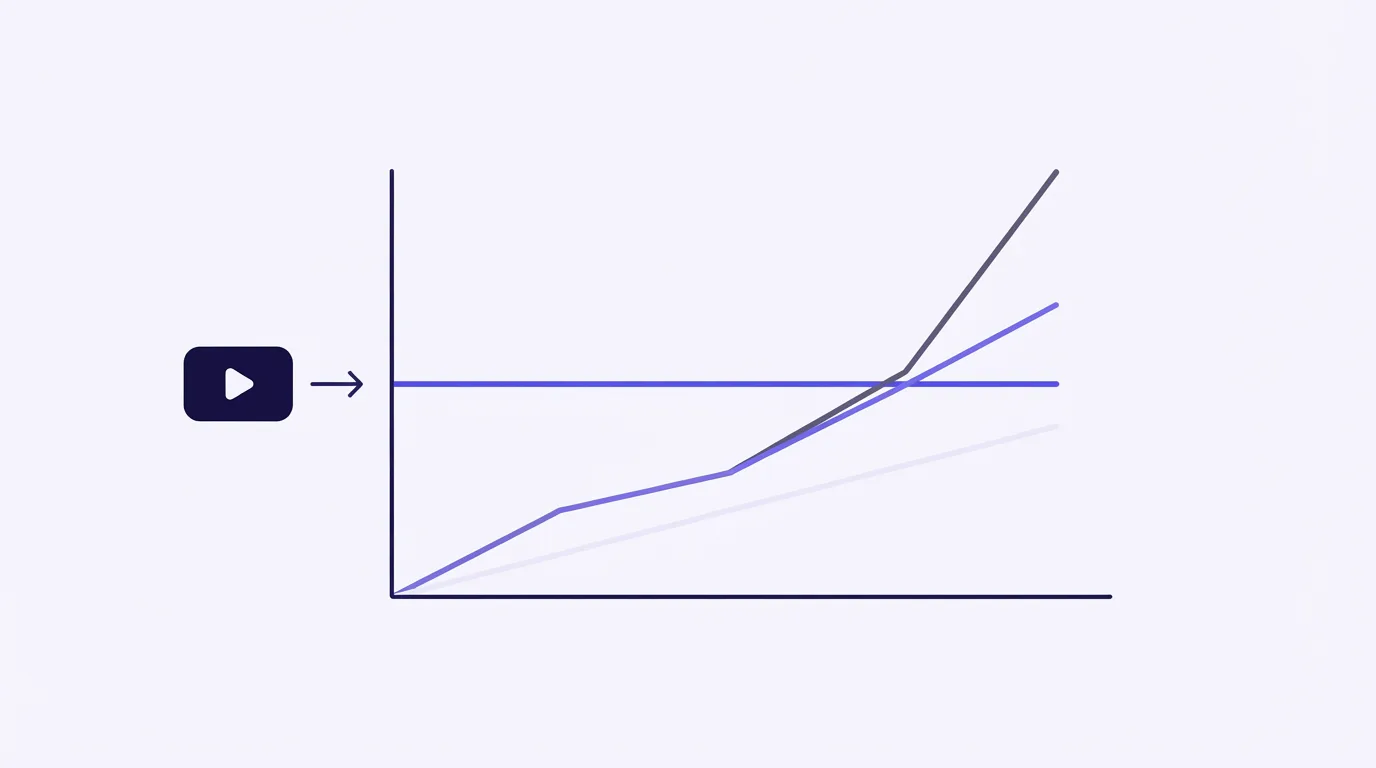
Per play
TrackPlay counts one billable play per viewer session in which the video was genuinely played, and its pricing page states that a muted autoplay nobody unmutes is not a play. Length and watch time do not change the count. Basic includes 5,000 plays for $29 a month, with extra plays at $0.02 each if you switch overage on. See TrackPlay play-based pricing for the higher plans.
Per minute stored and delivered
Cloudflare Stream sells storage in prepaid blocks of $5 for 1,000 minutes and bills delivery afterwards at $1 per 1,000 minutes, according to its pricing documentation. Mux gives 100,000 delivery minutes a month free, then charges $0.0008 a minute for 720p, with storage at $0.0024 a minute. Both bill by duration, so file size and bitrate do not move the total. The Mux video pricing page has the plan detail.
Per gigabyte
Bunny Stream stores video at a cent per gigabyte in the default region. Standard delivery in Europe and North America is a cent per gigabyte, and the volume tier is half a cent per gigabyte, with a $1 monthly minimum (Bunny Stream pricing). Panda Video and Vidalytics put a bandwidth allowance inside each plan: Panda's Bronze includes 500 GB for $17.90 and charges $0.03 per extra GB, while Vidalytics Starter includes 100 GB for $24 a month and charges $0.33 per extra GB. Here the bitrate matters, since a sharper encode sends more gigabytes for the same minutes. More in Panda Video plans and Vidalytics pricing.
Flat plan
Voomly Plus costs $19 a month with unlimited bandwidth and 2 TB of storage, which is why it draws the flat line in the diagram (Voomly Cloud pricing). Wistia Business is flat at $79 a month billed annually until its 1 TB bandwidth allowance runs out (Wistia plan bandwidth). Marketers on Reddit warn that Wistia gets as expensive as Vimeo once you scale, which matches a cap of that size.
How the estimate is worked out
Minutes delivered = video length × monthly visitors × average share watched. Gigabytes delivered = minutes delivered × bitrate in Mbps × 60 ÷ 8 ÷ 1,000. Plays = visitors × the share who press play or unmute. Each host then gets the unit it bills on, priced at its list rate, and on tiered plans the calculator picks the cheapest plan that covers your usage.
The bitrate is my assumption, and it is the one input that moves every per-gigabyte figure. A 720p VSL at 3.33 Mbps uses about 1.5 GB an hour. If your encoder delivers more, raise it. Storage on Bunny counts one copy of the file at that bitrate. Where a plan's overage rate is not part of the estimate, the result says so and shows the plan price with "+ overage" rather than a guessed number.
Delivery on Cloudflare and Mux is billed after the month, and Cloudflare counts preloading in the player as delivery, so a sudden traffic spike lands on the next invoice with no hard cap in between. The play-based figure is an upper bound when you leave the play share at 100%.
Every rate comes from the vendor's own pricing page, linked below with the date it was read. We verify prices with the vendor before publishing, as set out in how we verify prices.
Each name below links to the vendor page its rates were read from, on 13 October 2026, with what the estimate assumes for that host.
- Mux: Above 100,000 minutes the 720p list rates apply, before any plan credit or minimum, and you build the sales features yourself.
- Bunny Stream: This figure uses the standard network in Europe and North America. Asia and Oceania, South America, and the Middle East and Africa are higher per gigabyte. The volume network is a lower worldwide rate and is not included here. Storage counts one copy of the file at your bitrate. Extra renditions add more.
- Voomly: Plus and the plans above it keep one flat price however much of the video is watched.
- Panda Video: Priced on Bronze plus its per-GB overage. Panda's larger plans are left out of the estimate.
- TrackPlay: Plays are capped at your visitors and scaled by the share who press play. A muted autoplay nobody unmutes is not counted. The no-card free plan is left out.
- Cloudflare Stream: Delivery is billed after the month with no hard spending cap, and preloading in the player counts as delivery.
- Wistia: Business list price, billed annually. Past 1 TB the estimate flags the excess and adds nothing for it.
- Vidalytics: Monthly prices from the bandwidth tiers in Vidalytics' help center. Free is priced only inside its 50 GB, and Premium overage is not in the figure.
Delivery cost or a sales player: what the bill buys
Bunny, Cloudflare and Mux sell delivery. Their low numbers buy bytes and minutes and a basic player, and everything a VSL leans on is left for you or a developer to build: sound-first autoplay, timed calls to action, retention split by buyers, a sale tied back to the play. The VSL players price those layers into the plan, which is why they sit higher in the table at modest volume.
TrackPlay is the pick if your VSL runs on paid traffic and you want the bill to follow people who actually watch. It is a VSL player and analytics platform for paid-traffic funnels. The player brings sound-first autoplay, timed CTAs and watch gates. Retention is drawn per second and split into buyers and non-buyers, and the cart-verified sale is posted back server-side to Meta, TikTok and GA4 on the play that earned it. Split tests are settled on sales under one embed. On cost, the muted visitors who scroll past never become plays, and a long video costs the same per play as a short one.
It is narrow by design. TrackPlay is built for paid-traffic VSL conversion, so it has none of the channels, SEO pages or webinar tooling of a Wistia, and it is a poor fit when the video's job is content marketing. A direct-response seller loses little by it, because none of those features sits on the path from the ad to the checkout. Its closest rivals on price and job are Vidalytics, which meters bandwidth, and Panda Video. Our ranking of the best video hosting for VSLs sets all of them side by side, and our page on why sellers leave YouTube embeds covers the free option.
My take
I'd run the calculator twice: once with your real watch rate, and once with the watch rate you hope a better edit will reach. I'd judge the hosts on the second run. If the cheapest one changes between the two, I would pick the model whose bill stays reasonable as the video improves, because a VSL that holds attention longer is exactly the one that gets more expensive on a minute or gigabyte meter. Then weigh the difference in dollars against what the player gives back. A $20 gap a month is small next to one extra sale that attribution or a split test helps you find, and large if all you need is a file that plays.
Frequently asked questions
Why does a VSL run up a bandwidth bill so quickly?
Why would plays and bandwidth give such different totals?
Is YouTube a free way to host a sales video?
Are these figures what I will be billed?
Which host is cheapest for a VSL?
Related reading
Changes to this page
- 13 October 2026: first published with eight hosts and their list rates.

Written by
Mara Vance
Editor
Mara edits the reviews and roundups on VSL Host Report. She looks at how a video player behaves on cold paid traffic: autoplay and unmute behaviour, per-second retention, timed CTAs, lead gates and load speed. She also maps what each host really costs, whether it bills per play, per gigabyte or per seat, and rebuilds the monthly bill for a typical VSL funnel. For each piece she reads long-term user reports across forums and review sites, works through the vendor's own docs and pricing, and confirms the numbers before a verdict goes live.
Last checked 2026-10-13